Plastic Cutting Boards as a Source of Microplastics in Food
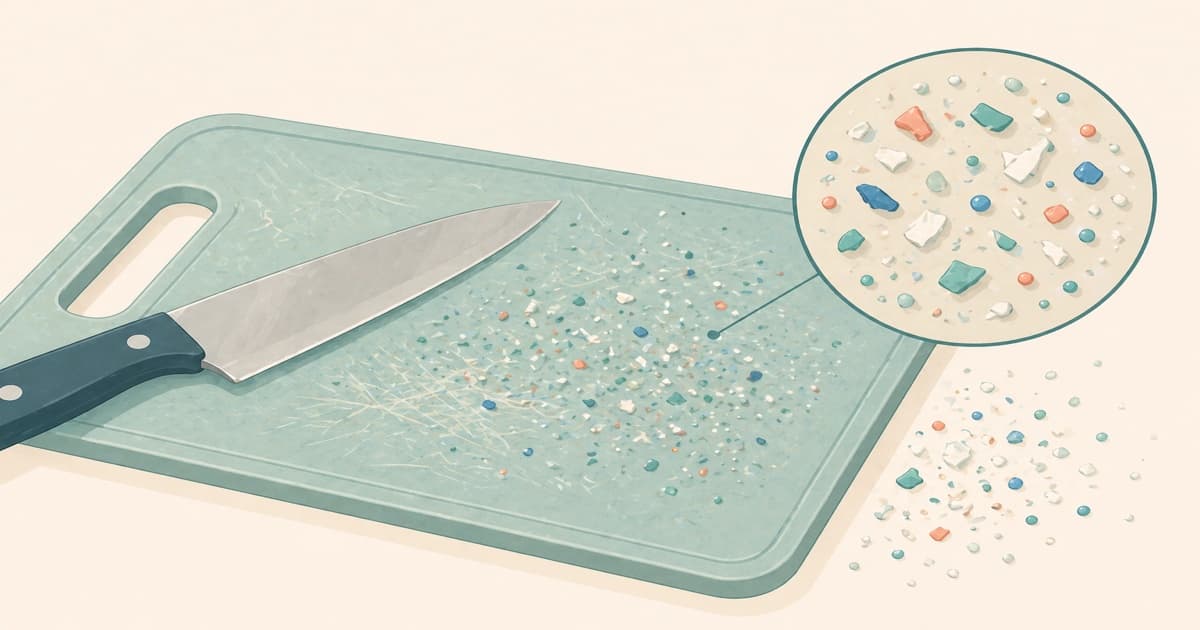
Plastic cutting boards are found in most kitchens. Research now shows they are a significant and underappreciated source of microplastic contamination in food — releasing particles with every knife stroke.
Find out your current exposure level
12 questions · 2 minutes · based on peer-reviewed science
Key takeaways
- → Plastic cutting boards are a significant and overlooked source of microplastic contamination in food (Yadav et al., 2023)
- → Polypropylene boards release more particles than polyethylene boards
- → PP cutting board particles have been shown to impair the intestinal barrier; PE particles disrupt gut microbiota in laboratory studies (Gan et al., 2025)
- → Switching to wood or bamboo eliminates this exposure source entirely — these materials do not shed plastic particles
What the research found
Yadav et al. (2023) in Environmental Science & Technology identified plastic cutting boards as a significant and previously overlooked source of microplastic contamination in food, with particles shed directly onto food surfaces during normal cutting use.
The study examined polypropylene (PP) and polyethylene (PE) boards — the two most common materials in household cutting boards — and found that PP boards released more particles than PE boards under the same cutting conditions. Both, however, represent a meaningful ongoing exposure source for anyone who cooks regularly.
The study noted that board age and surface damage significantly increased particle release — worn, scratched boards shed substantially more than new ones.
What happens to the particles in the body
Gan, Chen et al. (2025) in Environmental Health Perspectives examined the downstream effects of cutting board microplastics specifically. Mouse diets were prepared on PP, PE, and wooden cutting boards over 4 and 12 weeks. PP board particles were found to impair intestinal barrier function and induce inflammatory markers in gut tissue. PE board particles were associated with disruption of gut microbiota composition — including a significant decrease in Firmicutes — and altered liver and fecal metabolites in exposed animals.
These are animal studies and cannot be directly extrapolated to human outcomes, and the concentrations used were relatively high. However, they are consistent with the broader body of research showing that ingested microplastic particles accumulate in gut tissue and trigger inflammatory responses.
How cutting boards compare to other kitchen sources
The kitchen contains several significant microplastic sources. Microwaving food in plastic containers releases the most particles by concentration — up to 4.22 million microplastic particles per square centimetre of surface (Hussain et al., 2023). Cutting boards are a lower-intensity but constant daily source, accumulating across hundreds of meals per year.
Snekkevik et al. (2024) in Heliyon reviewed microplastic sources in the household kitchen and identified plastic cutting boards, plastic food storage containers, and scratched non-stick cookware as significant contributors.
What to use instead
Wood and bamboo cutting boards do not release synthetic polymer particles. Research on wooden board safety has focused primarily on bacterial retention in knife grooves — a concern that standard cleaning practices largely address. Glass cutting boards release no polymer particles but are harder on knife edges and louder to use. Toughened glass and end-grain wood boards are the best-evidenced alternatives.
If replacing a plastic cutting board immediately is not practical, the priority should be on boards that are visibly scratched or heavily grooved — these release the most particles and are the highest-impact items to replace first. A new plastic board releases fewer particles than an old one, but a wood or bamboo board releases none.
The bottom line
Plastic cutting boards are a daily microplastic source that most people have not considered. The exposure is not as dramatic as microwaving in plastic or using plastic tea bags, but it accumulates across hundreds of meals per year. Switching to wood, bamboo, or glass is a permanent fix that eliminates this pathway entirely — and is one of the more straightforward changes available in the home kitchen.
Related articles
Find out your personal exposure
12 questions · 2 minutes · peer-reviewed science
Start the calculator →References
- Yadav H et al. Cutting Boards: An Overlooked Source of Microplastics in Human Food? Environ Sci Technol. 2023. DOI: 10.1021/acs.est.3c00924
- Gan Z, Chen Q et al. Simulated Microplastic Release from Cutting Boards and Evaluation of Intestinal Inflammation and Gut Microbiota in Mice. Environ Health Perspect. 2025;133(3-4). DOI: 10.1289/EHP15472
- Snekkevik VK et al. Beyond the Food on Your Plate: Investigating Sources of Microplastic Contamination in Home Kitchens. Heliyon. 2024. DOI: 10.1016/j.heliyon.2024.e35022
- Hussain KA et al. Assessing the Release of Microplastics and Nanoplastics from Plastic Containers and Reusable Food Pouches. Environ Sci Technol. 2023. DOI: 10.1021/acs.est.3c01942