Microplastics in Seafood: Which Fish and Shellfish Have the Most
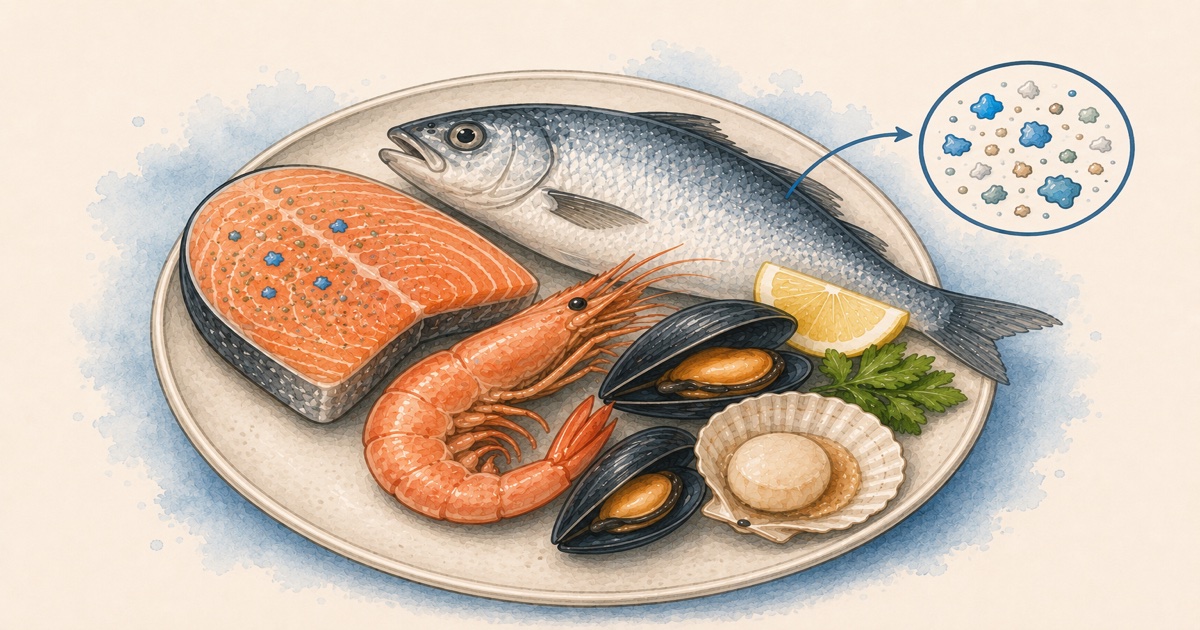
Seafood is a significant microplastic exposure pathway — but the amount varies enormously depending on what you eat and which part of the animal is consumed. Shellfish carry substantially higher exposure than fish fillets, for a specific biological reason.
Find out your current exposure level
12 questions · 2 minutes · based on peer-reviewed science
Key takeaways
- → Heavy shellfish consumers ingest up to 11,000 microplastic particles per year from shellfish alone (Van Cauwenberghe & Janssen, 2014)
- → Shellfish (mussels, oysters, clams) are eaten whole including the digestive tract — where microplastics accumulate — giving them far higher particle loads than fish fillets
- → Average mussel tissue contains 0.36 microplastic particles per gram (Van Cauwenberghe & Janssen, 2014)
- → Fish fillets have low microplastic content because the digestive tract — where particles concentrate — is removed before eating
- → Seafood is not a reason to avoid fish; it is a reason to understand that shellfish contribute more to dietary microplastic intake than finfish
Why it matters which part of the fish you eat
Microplastics that fish ingest from contaminated water concentrate primarily in the digestive tract. For large commercially harvested fish — salmon, cod, tuna, haddock — humans eat only the filleted muscle tissue, and the gut is discarded. This means the vast majority of the microplastic load in these fish never reaches the consumer.
The picture is fundamentally different for two categories of seafood:
- Shellfish (mussels, oysters, clams, scallops) — filter feeders consumed whole, digestive tract included
- Small whole fish (anchovies, sardines, whitebait) — consumed whole, including gut
For these categories, the consumer ingests whatever microplastics the animal has accumulated. For large filleted fish, exposure from the seafood itself is substantially lower.
Shellfish: the highest seafood exposure pathway
Shellfish are filter feeders — they pump large volumes of seawater through their bodies to extract food particles. In doing so, they also concentrate microplastics from the surrounding water. Van Cauwenberghe and Janssen (2014) in Environmental Pollution calculated that heavy shellfish consumers in Europe could ingest up to 11,000 microplastic particles per year from shellfish alone — based on measured microplastic loads in commercially grown mussels and oysters.
Mussels have been the most studied species. The same study found an average of 0.36 microplastic particles per gram of mussel tissue and 0.47 particles per gram in oysters, meaning a typical serving contains several hundred particles. Barboza et al. (2020) in Science of the Total Environment further found microplastics in 49% of commercially important wild fish from the NE Atlantic, including in dorsal muscle tissue — confirming that even the edible fillet carries some contamination, though at lower levels than whole shellfish.
Oysters show similar contamination levels to mussels. Rochman et al. (2015) found anthropogenic debris in 33% of individual Pacific oysters sampled from California fish markets.
Fish fillets: lower but not zero
For large fish consumed as fillets, the exposure from the seafood itself is considerably lower than shellfish — but not zero. Some microplastics do transfer from the gut into muscle tissue, and fish also absorb microplastics through their gills directly into the bloodstream. Cox et al. (2019) in Environmental Science & Technology estimated seafood as a whole contributes meaningfully to annual microplastic intake, but noted that fillet consumers have substantially lower exposure than shellfish consumers.
Smaller fish consumed whole — sardines, anchovies, sprats — carry higher exposure than large filleted fish because the entire body including the digestive tract is eaten.
How seafood compares to other exposure pathways
The practical implication: for most people, food preparation habits are a higher-leverage target for exposure reduction than seafood consumption choices.
Does cooking affect microplastic content?
There is limited research on whether cooking methods affect microplastic content in seafood. High-temperature cooking does not degrade plastic particles — microplastics are stable at cooking temperatures. However, some studies suggest that boiling shellfish may cause some particle transfer into cooking water that is then discarded. The effect is modest and not a primary mitigation strategy.
The more significant cooking-related risk is using plastic utensils, containers, or packaging during preparation — which can introduce additional particles irrespective of the seafood itself.
Should you eat less seafood?
The evidence does not support reducing seafood consumption on microplastic grounds alone. Seafood — including shellfish — provides significant nutritional value: omega-3 fatty acids, high-quality protein, zinc, iodine, and selenium. The microplastic contribution from even frequent shellfish consumption is one of many exposure pathways, and the other pathways (food preparation habits, water source, cookware) tend to be both larger and more controllable.
The more productive question is not "should I eat less seafood?" but "what are the highest-impact changes I can make across all my exposure pathways?" For most people, the answer involves changes to food preparation and water filtration before it involves seafood choices.
To see how seafood fits into your overall microplastic exposure profile alongside all other pathways, take the calculator below.
Related articles
Find out your personal exposure
12 questions · 2 minutes · peer-reviewed science
Start the calculator →References
- Van Cauwenberghe L & Janssen CR. Microplastics in bivalves cultured for human consumption. Environ Pollut. 2014. DOI: 10.1016/j.envpol.2014.06.010
- Barboza LGA et al. Microplastics in wild fish from North East Atlantic Ocean and its potential for causing neurotoxic effects, lipid oxidative damage, and human health risks associated with ingestion exposure. Sci Total Environ. 2020. DOI: 10.1016/j.scitotenv.2019.134625
- Rochman CM et al. Anthropogenic debris in seafood: Plastic debris and fibers from textiles in fish and bivalves sold for human consumption. Sci Rep. 2015. DOI: 10.1038/srep14340
- Cox KD et al. Human Consumption of Microplastics. Environ Sci Technol. 2019. DOI: 10.1021/acs.est.9b01517