Microplastics in Baby Formula and Breast Milk: What Parents Need to Know
Infants face disproportionately high microplastic exposure relative to their body weight — from plastic feeding bottles, formula preparation, and breast milk. Here is what the peer-reviewed evidence shows.
Find out your current exposure level
12 questions · 2 minutes · based on peer-reviewed science
Key takeaways
- → Polypropylene baby bottles used with boiling water release up to 16.2 million microplastic particles per litre (Li et al., 2020)
- → Infants fed formula from PP bottles may ingest up to 2.61 million microplastic particles per day in their first year — among the highest individual daily exposures in the literature
- → Microplastics were detected in 26 out of 34 breast milk samples in a peer-reviewed study (Ragusa et al., 2022)
- → Microplastics have also been found in human placenta — exposure begins before birth
- → Switching to glass or stainless steel bottles eliminates the bottle as an exposure source; never microwave formula in plastic
Plastic baby bottles: a major exposure source
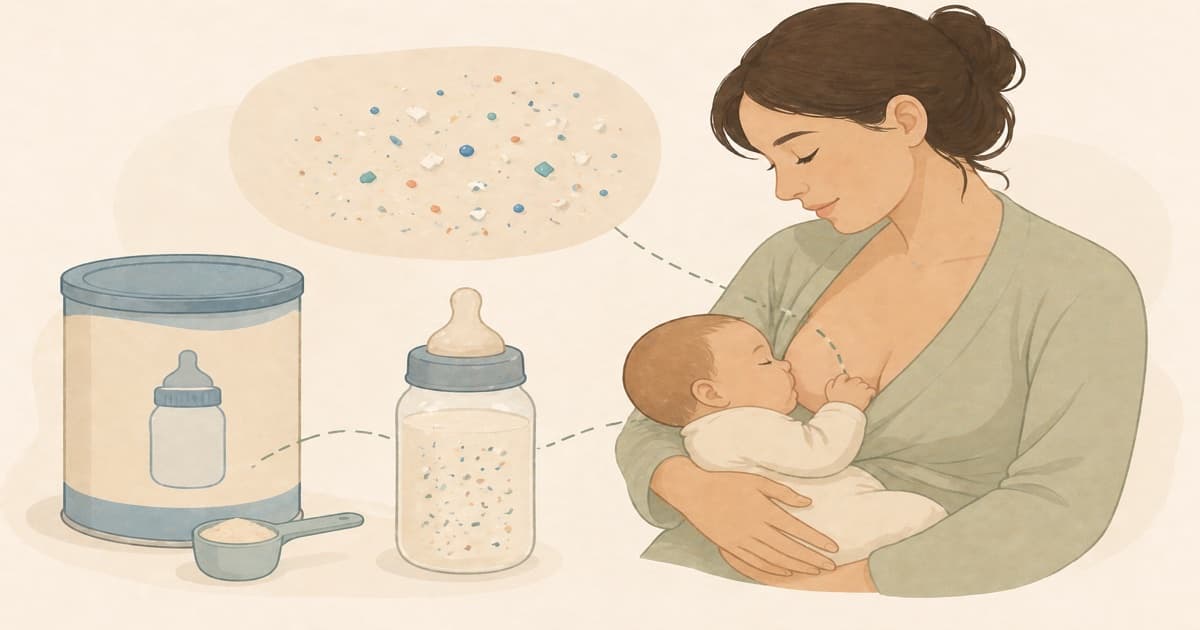
In 2020, Li et al. published a landmark study in Nature Food that quantified microplastic release from polypropylene (PP) baby bottles during formula preparation. When PP bottles were used with boiling water — as recommended for sterilisation — they released up to 16.2 million microplastic particles per litre.
The study estimated that North American and European infants fed formula from PP bottles may ingest up to 2.61 million polypropylene microplastic particles per day during the first year of life. This is among the highest estimated individual daily microplastic exposures reported in the literature — exceeding most adult exposure estimates on a per-bodyweight basis.
The mechanism is heat. Polypropylene releases particles when exposed to high temperatures, and the sterilisation and warming process for baby bottles creates exactly the conditions that maximise release. The study found that release was significantly lower when bottles were used with room-temperature or cooler water, though standard formula preparation typically involves warm or hot water.
Microplastics in breast milk
A 2022 study published in Polymers detected microplastics in 26 out of 34 breast milk samples collected from a cohort of Italian mothers. The polymers identified included polyethylene, polypropylene, and PVC — all common in food packaging and household plastics. This was the first peer-reviewed confirmation of microplastic presence in human breast milk.
The presence of microplastics in breast milk does not mean breastfeeding is harmful or should be avoided — the evidence on the health effects of these particles at the concentrations found remains limited, and breast milk provides significant documented benefits that far outweigh the risk posed by microplastic particles at current detected levels. The research does, however, establish that microplastic exposure begins before birth and continues through breastfeeding regardless of feeding method.
Exposure begins before birth
Microplastics have been detected in human placenta (Ragusa et al., 2021, Environment International). This establishes that microplastic exposure is not limited to feeding practices — it begins in utero and is a baseline condition for infants born today.
The significance of early-life exposure is an active area of research. Infant metabolising enzymes are underdeveloped compared to adults, and target organs including the gut, liver, and brain are in sensitive developmental periods. Whether microplastic exposure at detected concentrations causes harm during this window is not yet established — but the question is being actively studied.
Practical steps to reduce infant exposure from bottles
The Li et al. study included practical recommendations for reducing exposure during formula preparation using PP bottles, where glass or stainless steel alternatives are not used. Where possible, use water filtered through reverse osmosis or an activated carbon block filter to prepare formula, as this reduces the microplastic load in the water itself before it contacts the bottle.
- Sterilise the bottle separately — do not prepare formula inside the bottle during sterilisation. Sterilise with boiling water, empty the bottle, allow it to cool, then add formula prepared in a non-plastic container.
- Use glass or stainless steel bottles — these do not release polymer particles and eliminate the bottle as an exposure source entirely. Glass bottles with silicone sleeves for grip are widely available.
- Do not microwave formula in plastic bottles — this is the highest-risk preparation method for particle release. Warm bottles in warm water or use a bottle warmer with the formula transferred to a non-plastic container first.
- Replace bottles regularly — worn and scratched PP bottles release more particles than new ones. Visible scratching on the interior surface is a signal to replace.
What this means in context
The data on infant microplastic exposure is among the most concerning in the field, primarily because of the scale of estimated daily intake relative to body weight and the developmental sensitivity of the exposure window. It is also one of the areas where practical mitigation is clearest: switching from PP to glass or stainless steel bottles, and adjusting formula preparation to avoid heating inside plastic, are straightforward changes with meaningful impact.
The broader research on health outcomes from this level of exposure in infants is still developing. What is established is that the exposure is real, measurable, and higher than previously recognised — and that specific preparation practices significantly affect the dose.
Related articles
Find out your personal exposure
12 questions · 2 minutes · peer-reviewed science
Start the calculator →References
- Li D et al. Microplastic release from the degradation of polypropylene feeding bottles during infant formula preparation. Nat Food. 2020. DOI: 10.1038/s43016-020-00171-y
- Ragusa A et al. Plasticenta: First evidence of microplastics in human placenta. Environ Int. 2021. DOI: 10.1016/j.envint.2020.106274
- Ragusa A et al. Raman Microspectroscopy Detection and Characterisation of Microplastics in Human Breastmilk. Polymers. 2022. DOI: 10.3390/polym14132700