Does Reverse Osmosis Remove Microplastics?
Yes — and to a very high degree. Reverse osmosis is one of the most effective technologies available for removing microplastics from drinking water. Here's what the research shows.
Find out your current exposure level
12 questions · 2 minutes · based on peer-reviewed science
Key takeaways
- → Reverse osmosis achieves among the highest microplastic removal rates of any household filtration technology — some studies report above 99% removal (Acarer, 2023)
- → RO membrane pore size is less than 1 nanometre (Acarer, 2023) — far smaller than the smallest routinely detectable microplastic particles (~1 micron)
- → For comparison: ultrafiltration removes 85–99%, boiling hard tap water 80–90% (Yu et al., 2024), carbon-only pitcher-style filters are unreliable and can worsen results (Cherian et al., 2023)
- → Bottled water adds microplastics from plastic packaging — switching to RO-filtered tap water eliminates this exposure source
- → RO systems waste water (typically 3–4 litres per litre filtered) and remove beneficial minerals — a remineralisation filter is recommended
How reverse osmosis works
Reverse osmosis (RO) forces water under pressure through a semi-permeable membrane with pore sizes less than 1 nanometre (Acarer, 2023). To put this in context, the smallest microplastic particles that researchers routinely detect are around 1 micron — far larger than an RO membrane pore. Even nanoplastic particles, which are far smaller than microplastics, are typically 100–1,000 nanometres in size, still orders of magnitude larger than an RO membrane pore.
This size mismatch is why RO is so effective. Unlike simple sieving, RO membranes operate via a sorption-diffusion mechanism — but the practical outcome for particles as large as microplastics is the same: they cannot pass through (Acarer, 2023).
What the research shows
A 2023 study by Cherian et al. in Polymers evaluated common point-of-use devices using granular activated carbon (GAC), ion exchange resin, and microfiltration. The GAC and ion exchange device — with no physical membrane — resulted in effluent particle counts that exceeded the influent under some test conditions, meaning it added microplastics rather than removing them. By contrast, the device incorporating a 0.2 µm microfiltration membrane achieved 90–100% removal of plastic fragments. The authors concluded that point-of-use devices incorporating physical membrane barriers are the most suitable for microplastic removal, and explicitly called for future research into RO and solid block activated carbon devices.
Acarer (2023) in Water Science and Technology reviewed membrane technologies specifically for microplastic removal. The review confirmed that RO and nanofiltration membranes — with pore sizes below 1 nm — achieve some of the highest removal rates, with one study (Sun et al., 2021) reporting approximately 99.8% removal in a drinking water treatment setting. The review also noted that membrane technologies as a class outperform conventional treatment, and that conventional treatment plants show wide variation in removal efficiency depending on the technologies used.
How does it compare to other filters?
Across the reviewed literature, a clear performance hierarchy emerges for household and treatment-level filtration technologies:
| Filter type | Removal rate | Notes |
|---|---|---|
| Reverse osmosis | >99% | Most effective, wastes some water |
| Ultrafiltration membrane | 85–99% | Retains minerals, less water waste |
| Activated carbon block | Variable | Depends on pore size; carbon-only devices unreliable |
| Boiling (hard water) | 80–90% | Free, requires hard water |
| Pitcher filter (Brita-style) | Inconsistent | Carbon + ion exchange only — no physical membrane barrier |
| Bottled water | Adds particles | Not a solution — adds microplastics from packaging |
Sources: Acarer (2023) Water Sci Technol; Cherian et al. (2023) Polymers; Yu et al. (2024) EST Letters.
Under-sink vs countertop RO — which is right for you?
Both deliver the same >99% removal performance. The difference is practical:
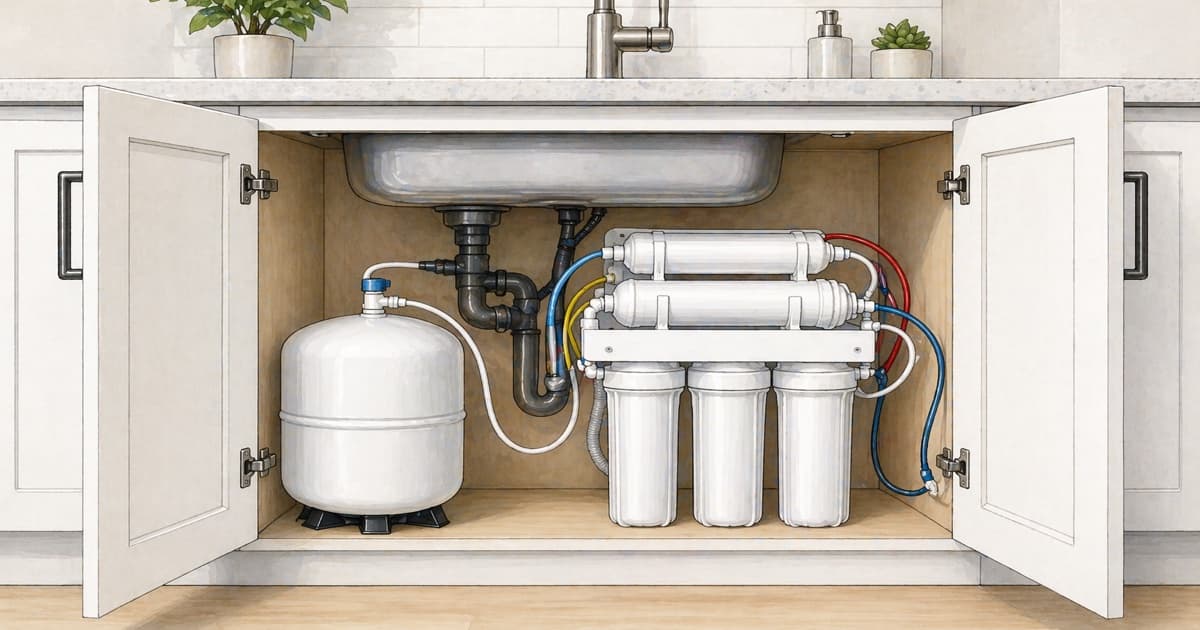
- Under-sink RO: Installed permanently beneath the kitchen sink with a dedicated tap. Stores filtered water in a tank ready to use. Best for homeowners or long-term renters. Higher upfront cost but more convenient day-to-day.
- Countertop RO: Sits on the counter, connects to the tap via an adaptor. No installation required. Good for renters or those who want to avoid plumbing work. Slower output than under-sink systems.
- RO water jugs: A newer category — gravity-fed RO units that require no installation. Slower than plumbed systems but portable and low-cost to start.
For households with infants where formula preparation is a significant exposure source, using RO-filtered water to prepare formula is one of the highest-impact changes available. The exposure reduction from switching formula water source alone is meaningful given the particle release rates documented in plastic bottles.
Does RO remove nanoplastics too?
This is where the evidence is more limited. Nanoplastics are defined as particles below 1 micron. The membrane pore size of a standard RO system is less than 1 nm (Acarer, 2023) — still smaller than even the smallest nanoplastics measured in studies. On theoretical grounds, RO should remove nanoplastics with similar efficiency to microplastics.
However, the measurement challenge is significant: nanoplastics are extremely difficult to detect and quantify reliably, so few studies have directly measured RO removal rates for nanoplastics specifically. The physics strongly supports high removal efficiency, but peer-reviewed confirmation at the nanoscale is limited.
Practical considerations
RO systems are effective but come with trade-offs. They waste water — a typical household RO unit produces 3–4 litres of waste water for every litre of filtered water, though more efficient models are available. They also remove beneficial minerals including calcium and magnesium, which some users remineralise back in. Countertop and under-sink systems are both available; under-sink systems with a storage tank are more convenient for daily use.
For most households, the choice between RO and a quality filter incorporating a physical membrane barrier comes down to cost versus performance. RO removes microplastics to a very high degree but costs more to install and maintain, and wastes water. A device with a sub-micron membrane (such as a solid block carbon filter rated to 0.2–0.5 µm) provides meaningful removal at lower cost. Both are dramatically better than bottled water or no filtration.
The bottom line
Yes, reverse osmosis removes microplastics — to a higher degree than any other readily available household water treatment technology. If reducing microplastic exposure from drinking water is a priority, RO is the most evidence-backed approach. For those who find RO impractical, boiling hard tap water (Yu et al. 2024) or using an activated carbon block filter are meaningful alternatives supported by published research.
Related articles
Find out your personal exposure
12 questions · 2 minutes · peer-reviewed science
Start the calculator →References
- Cherian AG et al. Microplastic Removal from Drinking Water Using Point-of-Use Devices. Polymers. 2023. DOI: 10.3390/polym15061331
- Acarer S. A review of microplastic removal from water and wastewater by membrane technologies. Water Sci Technol. 2023. DOI: 10.2166/wst.2023.186
- Tang KHD & Hadibarata T. Microplastics removal through water treatment processes: a critical review. Environ Challenges. 2021. DOI: 10.1016/j.envc.2021.100264
- Yu Z et al. Drinking Boiled Tap Water Reduces Human Intake of Nanoplastics and Microplastics. Environ Sci Technol Lett. 2024. DOI: 10.1021/acs.estlett.4c00081