Microplastics in Bottled Water — What the Research Shows
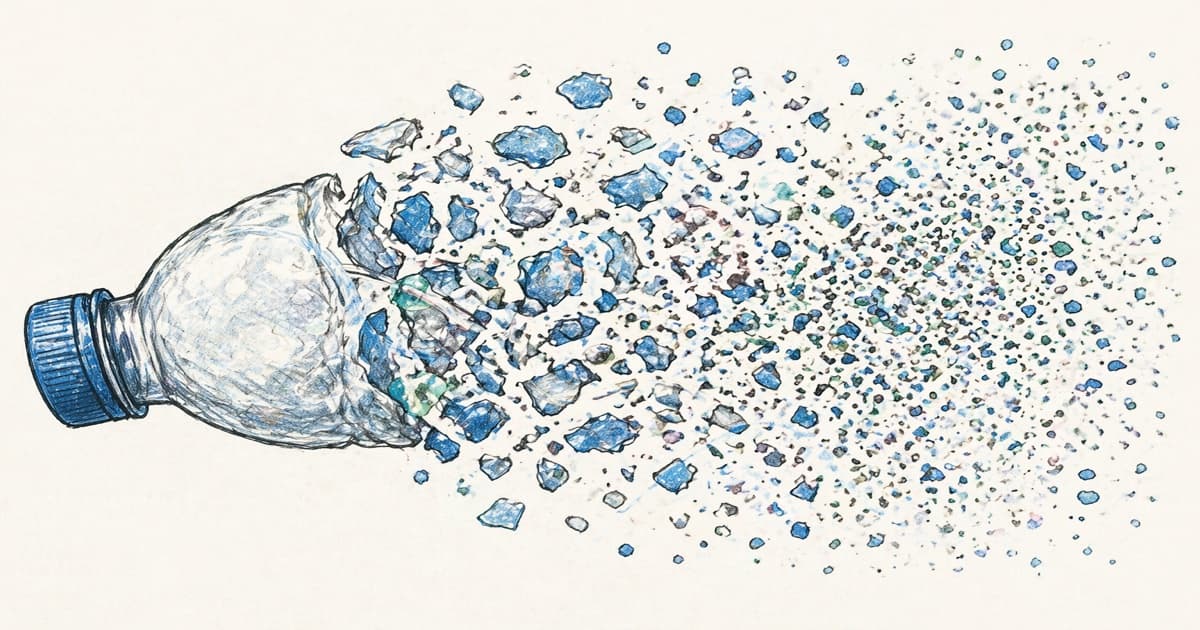
People drink bottled water to avoid contaminants. The evidence shows it introduces one: microplastic particles at concentrations significantly higher than filtered tap water.
Find out your current exposure level
12 questions · 2 minutes · based on peer-reviewed science
Key takeaways
- → 93% of bottled water samples across 11 global brands contained microplastics, averaging 325 particles per litre (Mason et al., 2018)
- → Some bottles exceeded 10,000 microplastic particles per litre — far higher than filtered tap water
- → The PET bottle and polypropylene cap are the primary contamination sources — not the water supply itself
- → Filtered tap water consistently has lower microplastic content than bottled water across the reviewed literature
- → Reverse osmosis filtered tap water reduces microplastic content to near zero — the single highest-impact water switch available
The global bottled water market is worth over $250 billion annually. It is sold on the premise of purity. Multiple peer-reviewed studies now document a consistent finding: bottled water contains microplastic particles, typically at concentrations higher than well-regulated tap water — and the plastic bottle itself is a primary source.
The landmark study: 259 bottles, 11 brands, 9 countries
Mason et al. (2018), published in Frontiers in Chemistry, analysed 259 individual bottles of water from 11 globally recognised brands purchased in 9 countries. The study found microplastic contamination in 93% of samples. The average concentration was 325 microplastic particles per litre, with some bottles exceeding 10,000 particles per litre.
The most common polymer identified was polypropylene — the same material used in bottle caps — followed by nylon and polyethylene terephthalate (PET), which is the material the bottles themselves are made from. This strongly suggested the bottle and cap were the primary contamination source rather than the water supply used to fill them.
The study also identified industrial lubricant particles, consistent with the bottling process. A fragment of blue industrial netting was found in one sample. The findings prompted an inquiry from the World Health Organization, which subsequently launched a review of microplastics in drinking water.
How bottled water compares to tap water
Danopoulos et al. (2020) in PLOS ONE performed a systematic review of microplastic contamination in drinking water, covering 12 studies across tap and bottled water. The most common polymers identified were PET and polypropylene — consistent with bottle and cap materials as contamination sources. The maximum reported contamination was 628 MPs/L for tap water and 4,889 MPs/L for bottled water in European samples. The authors noted high statistical heterogeneity across studies, which limits direct comparison, but the direction of the evidence was consistent: bottled water showed higher contamination than tap water across the reviewed literature.
It is important to be precise here: unfiltered tap water does contain microplastics — typically in the range of 1–30 particles per litre in studies of treated municipal water in developed countries. This is substantially lower than the 325 average found in bottled water by Mason et al., but it is not zero. The best-performing option for water-source microplastic exposure is filtered or boiled tap water, not bottled water.
What drives contamination in bottled water?
The evidence points to three primary sources:
- The PET bottle itself — polyethylene terephthalate slowly releases particles into the water, with release increasing over time and with temperature. PET is the primary polymer found in most bottled water microplastic analyses.
- The cap and seal — polypropylene caps shed particles, particularly during the opening process. Mason et al. noted polypropylene as the most frequently identified polymer in their samples.
- The industrial bottling process — filling equipment, conveyor systems, and industrial packaging materials contribute particle contamination during the bottling process itself.
Does the type of bottle matter?
Glass-bottled water has not been as extensively studied as PET-bottled water, but the available evidence suggests significantly lower microplastic contamination when glass packaging is used, for the obvious reason that glass does not shed polymer particles. The remaining contamination in glass-bottled water is primarily attributed to the industrial bottling process and cap materials, not the container itself.
Single-use PET bottles perform worse than multi-use polycarbonate or stainless steel containers that are refilled with filtered tap water — both in terms of microplastic exposure and environmental impact.
The practical takeaway
If you are drinking bottled water to avoid contaminants, you are solving one problem while introducing another. The evidence consistently shows that filtered tap water — using reverse osmosis, activated carbon block, or even simple boiling for hard water — delivers lower microplastic exposure than bottled water, at lower cost.
The switch from daily bottled water to filtered tap water represents one of the highest-impact, lowest-effort reductions available. Mason et al. (2018) found bottled water averages 325 microplastic particles per litre — compared to effectively zero from a well-maintained reverse osmosis filter — making this one of the most straightforward exposure reductions a person can make.
Related articles
Find out your personal exposure
12 questions · 2 minutes · peer-reviewed science
Start the calculator →References
- Mason SA et al. Synthetic Polymer Contamination in Bottled Water. Front Chem. 2018. DOI: 10.3389/fchem.2018.00407
- Danopoulos E et al. Microplastic contamination of drinking water: a systematic review. PLOS ONE. 2020. DOI: 10.1371/journal.pone.0236838