Microplastics in Salt: Is Sea Salt Making You Eat More Plastic?
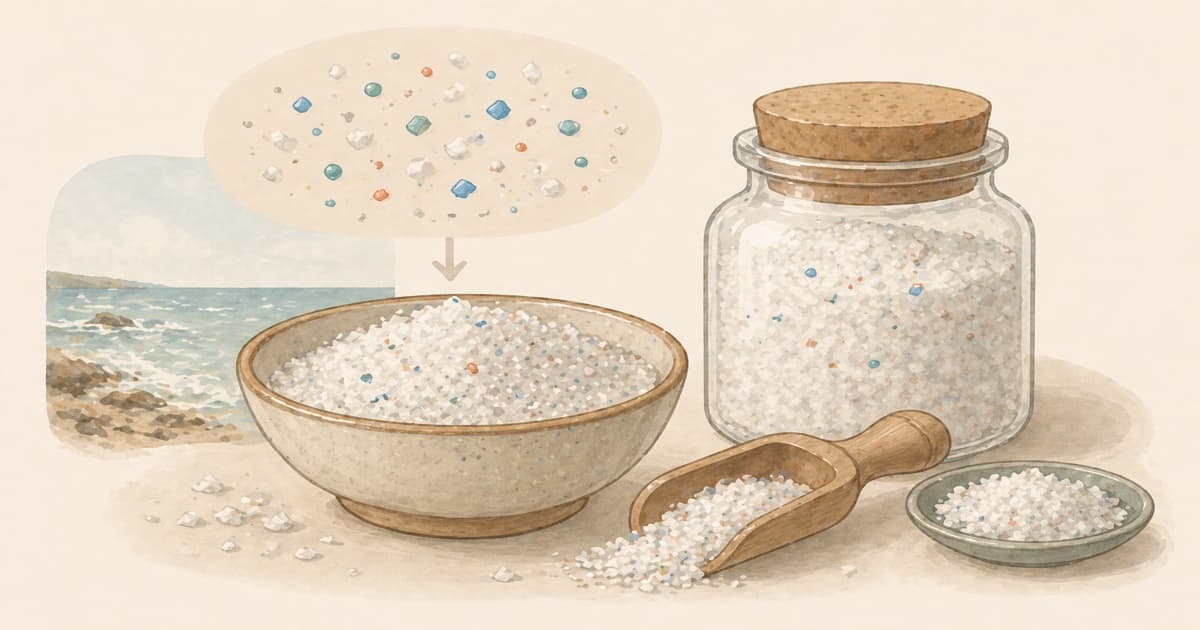
Sea salt is marketed as natural and minimally processed. Research shows it is also the most microplastic-contaminated type of salt available — a direct consequence of ocean plastic pollution.
Find out your current exposure level
12 questions · 2 minutes · based on peer-reviewed science
Key takeaways
- → 92% of commercial salt brands globally contain microplastics — tested across 39 brands from 21 countries (Kim et al., 2018)
- → Sea salt is the most contaminated type, with concentrations up to 1,674 particles/kg; rock salt is the least contaminated (0–148 particles/kg)
- → An adult consuming the WHO-recommended 5g of salt per day ingests approximately 2,000 microplastic particles per year from salt alone
- → Salt contamination reflects ocean plastic pollution — sea salt harvested from contaminated coastal waters carries the highest particle loads
- → Switching to rock salt or refined table salt is a simple swap that reduces exposure from this source
The global study: 39 brands, 21 countries
Kim et al. (2018) in Environmental Science & Technology conducted the most comprehensive analysis of microplastics in commercial salt to date. The team sampled 39 salt brands purchased from 21 countries across Europe, North America, and Asia. The findings were unambiguous: 92% of salt brands contained microplastic particles.
The contamination varied significantly by salt type. Sea salt showed the highest concentrations — ranging from 0 to 1,674 microplastic particles per kilogram (excluding one Indonesian outlier at 13,629 n/kg), with a mean substantially higher than other salt types. Lake salt showed moderate contamination (28–462 particles/kg), while rock salt had the lowest (0–148 particles/kg). Refined table salt, which undergoes additional processing, tended to have lower particle counts than unrefined sea salt.
The contamination level in sea salt correlated directly with the volume of plastic waste entering rivers and oceans in nearby regions — making sea salt effectively a microplastic index of local ocean pollution. Brands sourced from more polluted coastlines showed higher particle counts than those from less affected waters.
Why sea salt is more contaminated than other types
Sea salt is produced by evaporating seawater — either in open-air salt pans or through industrial evaporation. Because it is derived directly from ocean water, any microplastics suspended in the water are concentrated into the final product alongside the sodium chloride.
Rock salt and mined salt, by contrast, come from ancient underground deposits formed millions of years before plastic existed. They contain no synthetic polymers by origin. Any contamination in rock salt comes from the mining or packaging process, not the source material — which is why these types consistently show lower particle counts.
How much do you ingest from salt?
Using the Kim et al. data and standard dietary sodium intake figures, an adult consuming the WHO-recommended maximum of 5g of salt per day would ingest anywhere from under 100 to over 2,000 microplastic particles per year from salt alone, depending on the origin of the salt (Peixoto et al., 2019). European and North American sea salts typically sit at the lower end of this range; highly contaminated Asian sea salts at the higher end.
This makes dietary salt a moderate but consistent exposure source. It is not in the same category as microwaving food in plastic or using plastic tea bags, but it contributes meaningfully to cumulative annual intake — and unlike some exposure sources, it is present at every meal.
Does the type of salt matter for health reasons beyond microplastics?
The health literature on sea salt versus table salt has focused primarily on mineral content and iodine supplementation — not microplastics. Sea salt does contain trace minerals absent in refined table salt, but these are present in quantities too small to be nutritionally significant for most people. The choice between salt types for mineral content is essentially a marketing argument.
When microplastic content is added to the comparison, the picture changes. Rock salt and refined table salt have meaningfully lower particle contamination than unrefined sea salt. For people who use significant quantities of salt in cooking and at the table, switching from sea salt to rock salt or refined iodised salt is a simple change that reduces one dietary exposure pathway.
What the research doesn't yet tell us
The 2018 Kim et al. study remains the most comprehensive global analysis. Since then, several regional studies have confirmed the pattern of sea salt contamination, and a 2025 critical review by De Nido et al. in the Journal of Chromatography Open confirmed that sea salt consistently shows the highest contamination across salt types globally, with fibres as the most commonly detected morphology and particles under 500 μm as the most frequently reported size class. However, the health effects specifically from salt-derived microplastic ingestion have not been studied in isolation — the data on dose, accumulation, and long-term effects comes from the broader microplastics literature, not salt-specific research.
Practical guidance
If reducing microplastic exposure from salt is a priority, rock salt or refined iodised table salt has a lower particle burden than unrefined sea salt. This is not a dramatic intervention — salt contributes a relatively small fraction of total microplastic intake compared to sources like plastic cookware and containers — but it is an easy swap with no downside. The minerals marketed in sea salt are nutritionally negligible, and rock salt used in cooking performs identically.
Related articles
Find out your personal exposure
12 questions · 2 minutes · peer-reviewed science
Start the calculator →References
- Kim JS et al. Global Pattern of Microplastics (MPs) in Commercial Food-Grade Salts: Sea Salt as an Indicator of Seawater MP Pollution. Environ Sci Technol. 2018. DOI: 10.1021/acs.est.8b04180
- Peixoto D et al. Microplastic pollution in commercial salt for human consumption: A review. Estuar Coast Shelf Sci. 2019;219:161–168. DOI: 10.1016/j.ecss.2019.02.018
- De Nido CG et al. Microplastics in salt: A critical review of contamination, analytical methodologies, and health implications. J Chromatogr Open. 2025;8:100276. DOI: 10.1016/j.jcoa.2025.100276