Microplastics in Tea Bags: How Many You're Drinking and What to Use Instead
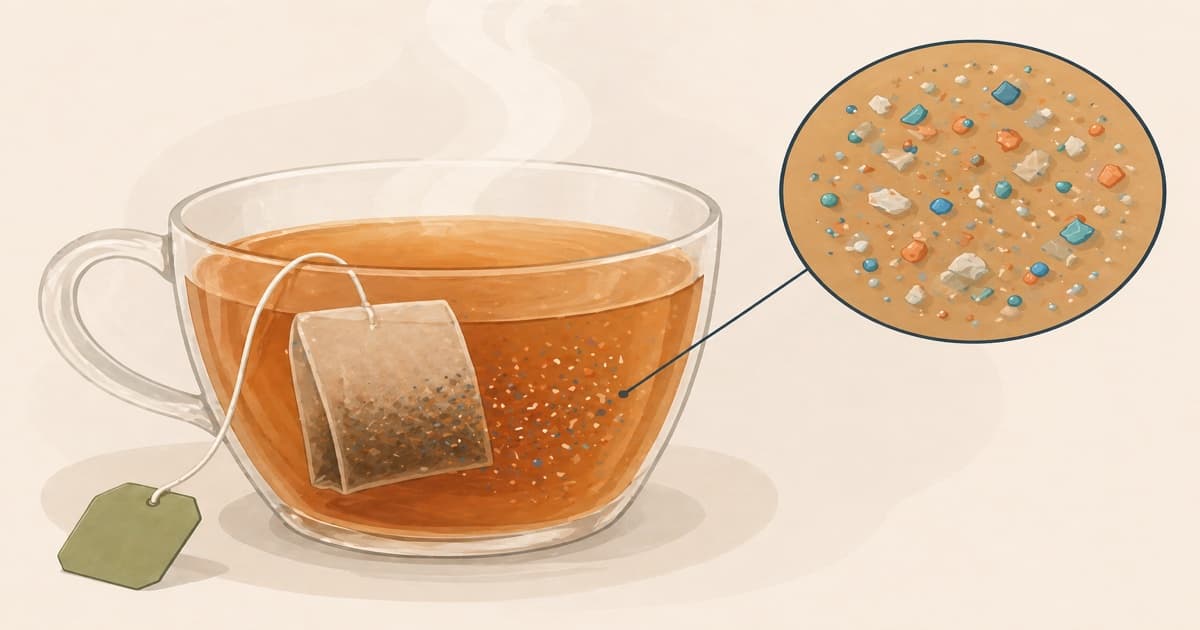
Tea is the second most consumed beverage in the world. For the many millions who brew it in a plastic or nylon bag, each cup delivers billions of microplastic and nanoplastic particles alongside the flavour.
Find out your current exposure level
12 questions · 2 minutes · based on peer-reviewed science
Key takeaways
- → A single plastic tea bag releases approximately 11.6 billion microplastic and 3.1 billion nanoplastic particles per cup at brewing temperature (Hernandez et al., 2019)
- → The particles come from the nylon or PET mesh bag itself disintegrating under heat — not from the tea or water
- → Paper bags with staple or folded seals (no plastic adhesive) release negligible particle counts by comparison
- → Loose-leaf tea in a stainless steel or glass infuser eliminates this exposure source entirely
The 2019 study that changed the picture
In 2019, Hernandez et al. published a study in Environmental Science & Technology that became one of the most widely cited findings in microplastics research. The team steeped single-use plastic and nylon tea bags at normal brewing temperature (95°C) and analysed the water.
The result: a single plastic tea bag releases approximately 11.6 billion microplastic and 3.1 billion nanoplastic particles per cup. To put this in context, that is orders of magnitude higher than the concentration found in bottled water — which itself is considered a high-exposure source.
The primary polymers identified were nylon-6,6 and polyethylene terephthalate (PET) — the same materials used to make the mesh bags themselves. The particles were not coming from the tea or the water; they were coming from the bag disintegrating under heat.
What the broader research shows
A 2025 systematic review by Fard et al. in Food Chemistry synthesised 19 published studies on MNPs in tea-based beverages and confirmed that plastic teabags are consistently the dominant source — with particle concentrations from steeped plastic bags several orders of magnitude higher than those found in bottled tea or beverages made from loose leaves. The review also noted that at least one study examined the effects of varying steeping time up to 12 hours, suggesting that leaving a bag in the cup while drinking may compound the exposure.
Reported particle counts vary considerably across studies, partly due to differences in analytical methods and size detection limits, and partly due to variation between brands and bag materials. What is consistent across studies is the direction: plastic teabags in hot water release far more MNPs than virtually any other dietary source.
Hernandez et al. also found that the vast majority of released particles were submicron — 14.7 billion submicron particles versus 2.3 million micro-sized particles per bag. Submicron and nanoplastic particles are considered more concerning than larger microplastics because of their greater capacity to cross biological barriers including the gut wall.
Are paper tea bags safe?
Not automatically. Many paper tea bags are sealed with a thin strip of polypropylene to hold the bag closed under heat. These bags release fewer particles than full plastic mesh bags, but are not particle-free. The safest paper bags are those with a staple or folded seal — no plastic adhesive — and these do release negligible particle counts by comparison.
The key distinction is between the mesh body of the bag and the seal. A paper bag with a polypropylene heat seal will release far fewer particles than a full nylon mesh bag, but more than a paper bag with a staple or fold.
How to identify plastic tea bags
The easiest test: hold the empty bag up to light. Plastic mesh bags (nylon, PET) are slightly translucent and have a smooth, silky texture. Paper bags feel rougher and are opaque. If you are unsure, check the brand's packaging — many now specify "plastic-free" explicitly in response to consumer pressure.
Brands that have committed to plastic-free bags include several major UK and European tea producers. Many supermarket own-brand bags, however, still use plastic mesh or polypropylene-sealed paper.
The practical solution
Loose-leaf tea brewed in a stainless steel or glass infuser eliminates this exposure pathway entirely. The particle release from loose-leaf tea prepared this way is negligible. For those who prefer bags for convenience, paper bags with a staple or folded seal — verified as plastic-free — are a significant improvement over plastic mesh bags.
For daily tea drinkers using plastic bags, this is one of the single largest controllable microplastic exposure sources. The fix is both cheap and simple.
Related articles
Find out your personal exposure
12 questions · 2 minutes · peer-reviewed science
Start the calculator →References
- Hernandez LM et al. Plastic Teabags Release Billions of Microparticles and Nanoparticles into Tea. Environ Sci Technol. 2019. DOI: 10.1021/acs.est.9b02540
- Fard NJH et al. Microplastics and nanoplastics in tea: Sources, characteristics and potential impacts. Food Chem. 2025;466:142111. DOI: 10.1016/j.foodchem.2024.142111