Best Water Filter for Microplastics: RO vs Carbon vs Pitcher, Ranked
Drinking water is one of the most significant microplastic exposure pathways — but not all filters address it equally. Here is what the peer-reviewed evidence and filter physics say about each filter type, ranked by expected removal performance.
Find out your current exposure level
12 questions · 2 minutes · based on peer-reviewed science
Key takeaways
- → Reverse osmosis membranes have pore sizes of approximately 0.0001 microns — far smaller than any known microplastic particle — making them the most effective home filtration option based on physical size exclusion
- → Activated carbon block filter performance varies significantly by quality; low-quality activated carbon filters with plastic housings have been shown to increase rather than decrease microplastic counts (Da Costa et al., 2024)
- → Boiling hard tap water removes at least 80% of free-floating microplastics at no cost (Yu et al., 2024); the effect is considerably lower in soft water
- → Standard pitcher filters (Brita-style) are not reliably effective for microplastic removal — their pore sizes (20–50 µm) allow most tap water microplastics to pass through
- → Bottled water is not a solution — it adds microplastics (avg. 325 particles/litre) rather than removing them (Mason et al., 2018)
Bottled water drinkers consume significantly more microplastics than those drinking filtered tap water — and bottled water itself is a significant source, averaging 325 particles per litre across 11 major brands. Switching your water source is one of the most accessible exposure reductions available. But the filter type matters enormously.
How filter pore size determines microplastic removal
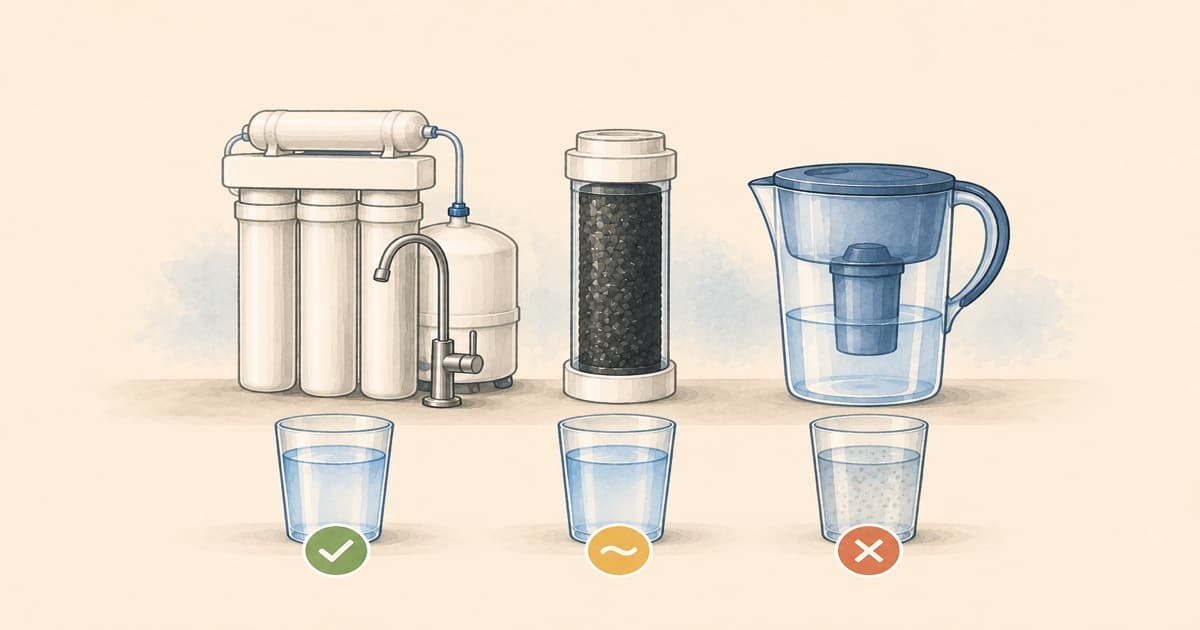
Microplastics are defined as particles ≥1 micron. The primary mechanism by which filters remove them is physical size exclusion: particles larger than a filter's pore size cannot pass through. This makes pore size the most reliable predictor of microplastic removal performance, and the ranking below is based on this principle alongside available peer-reviewed data.
| Filter type | Pore size | Expected MP removal | Verdict |
|---|---|---|---|
| Reverse osmosis (RO) | ~0.0001 µm | Near-complete | Best available |
| Ultrafiltration membrane | ~0.01–0.1 µm | Near-complete for MPs ≥1 µm | Very good |
| Activated carbon block | ~0.5–10 µm | Varies by quality | Quality-dependent |
| Boiling (hard water) | — | ≥80% | Effective, free |
| Boiling (soft water) | — | Considerably lower | Check local hardness |
| Pitcher filter (Brita-style) | ~20–50 µm | Inconsistent | Not reliable for microplastics |
| Bottled water | — | Negative (adds particles) | Not a solution |
Sources: Yu et al. (2024) EST Letters; Mason et al. (2018) Front Chem; Balkenbusch et al. (2025) npj Clean Water; Da Costa et al. (2024) Water.
1. Reverse osmosis — the strongest option
Reverse osmosis membranes have pore sizes of approximately 0.0001 microns. The smallest detectable microplastic particles are around 1 micron — making them 10,000 times larger than an RO membrane pore. Based on this physical size exclusion, an intact RO membrane provides no pathway for microplastic particles to pass through.
This is a physical certainty rather than a measured average: it follows from the pore size alone, in the same way that a 1 mm mesh cannot pass a 10 mm stone. Studies at large municipal water treatment facilities confirm near-complete microplastic removal using membrane filtration processes, with ultrafiltration achieving 99.3–100% across ten facilities in a 2025 study (Balkenbusch et al.). Direct peer-reviewed studies specifically testing home RO units against microplastics are limited, but the size exclusion mechanism applies regardless of scale.
Trade-offs: RO systems waste water (typically 3–4 litres for every litre filtered, though more efficient models exist), remove beneficial minerals, and require installation and periodic membrane replacement. Under-sink systems with a storage tank are the most practical for daily use. Countertop RO units exist for renters.
Best for: Anyone prioritising the highest possible microplastic reduction from drinking water, or households with infants where exposure reduction is most critical.
2. Ultrafiltration membranes
Ultrafiltration (UF) uses membranes with pore sizes of around 0.01–0.1 microns — larger than RO but still well below the minimum size of microplastics (1 micron). Based on size exclusion, UF membranes should theoretically retain all microplastic particles under normal operating conditions. This is supported by large-scale data: a 2025 study across ten municipal drinking water treatment facilities found UF achieved 99.3–100% microplastic removal (Balkenbusch et al.). UF systems do not remove dissolved minerals (unlike RO), which some users prefer for taste, and they waste less water.
Trade-offs: Less widely available as consumer products than RO. Performance depends on membrane integrity — a damaged or bypassed membrane will not provide the same barrier. For particles at the very small end of the microplastic range approaching 1 micron, the margin between particle size and pore size is narrower than with RO.
3. Activated carbon block filters
Activated carbon block (ACB) filters — distinct from the granular activated carbon used in standard pitcher filters — have pore sizes typically in the range of 0.5–10 microns. Based on pore size alone, a high-quality carbon block filter rated at 0.5 microns should capture the majority of microplastics. However, the picture from field research is more complicated.
A peer-reviewed study testing activated carbon tap filters in Brazil (Da Costa et al., 2024) found that water from these filters contained higher microplastic concentrations than unfiltered tap water. The researchers attributed this to the plastic components of the filter housing shedding additional particles into the water. This finding highlights that filter housing material and overall build quality matter as much as the pore size rating of the filter medium itself.
Trade-offs: Lower cost and easier installation than RO. Does not waste water or remove minerals. Performance varies significantly by product quality. Look specifically for carbon block filters rated for sub-micron particles and with non-plastic wetted components where possible — not all activated carbon products are equivalent.
4. Boiling — the free option that actually works (for hard water)
A 2024 study by Yu et al. in Environmental Science & Technology Letters found that boiling hard tap water removed at least 80% of free-floating microplastics and nanoplastics. The mechanism: calcium carbonate in hard water precipitates during boiling and encapsulates microplastic particles, which then settle with the calcium deposits. Carefully decanting the cooled water leaves most of the particles behind.
For soft water, the effect is considerably lower because there is insufficient calcium carbonate to drive the encapsulation mechanism. Check your local water hardness to determine whether boiling is likely to be effective where you live.
Best for: A cost-free intervention in hard water areas. Not a substitute for membrane filtration but a meaningful reduction for those without access to filtration equipment.
5. Pitcher filters — not reliably effective
Standard pitcher filters — including Brita-style granular activated carbon models — have pore sizes in the range of 20–50 microns. Most microplastics in tap water are smaller than 20 microns, meaning the majority will pass straight through. These filters are effective for improving taste and reducing chlorine, but should not be relied upon for meaningful microplastic reduction. The pore size mismatch is the fundamental problem: the filter was not designed to capture particles at this scale.
What about bottled water?
Bottled water is not a filtration solution — it is itself a source. Mason et al. (2018) found that 93% of bottled water samples across 11 global brands and 9 countries were contaminated with microplastics, averaging 325 particles per litre. The primary source is the bottle and cap, not the water supply. PET bottles also continue leaching particles over time, particularly when stored warm. Filtered tap water consistently outperforms bottled water for microplastic content.
Which filter is right for you?
- Highest reduction, cost not a barrier: Under-sink reverse osmosis
- Renting or can't install under-sink: Countertop RO unit or high-quality activated carbon block filter rated for sub-micron particles
- Hard water area, low budget: Boiling tap water (at least 80% removal at no cost)
- Households with infants: RO — infant exposure is among the highest documented, and formula preparation with filtered water meaningfully reduces the dose
- Already have a pitcher filter: It helps with taste, not reliably with microplastics — consider upgrading to a carbon block or RO system
Water is not the only microplastic exposure pathway — but it is one of the most controllable. For a full picture of where your exposure is coming from, including food preparation, cookware, and air, see our ranked guide to avoiding microplastics.
Related articles
Find out your personal exposure
12 questions · 2 minutes · peer-reviewed science
Start the calculator →References
- Yu Z et al. Drinking Boiled Tap Water Reduces Human Intake of Nanoplastics and Microplastics. Environ Sci Technol Lett. 2024. DOI: 10.1021/acs.estlett.4c00081
- Mason SA et al. Synthetic Polymer Contamination in Bottled Water. Front Chem. 2018. DOI: 10.3389/fchem.2018.00407
- Balkenbusch C et al. Microplastic removal across ten drinking water treatment facilities and distribution systems. npj Clean Water. 2025;8:103. DOI: 10.1038/s41545-025-00444-2
- Da Costa ID et al. Are Water Filters Effective Against Microplastics? Water. 2024;16(22):3189. DOI: 10.3390/w16223189
- Cherian AG et al. Microplastic Removal from Drinking Water Using Point-of-Use Devices. Polymers. 2023. DOI: 10.3390/polym15061331