Microplastics in the Brain: What the Research Shows
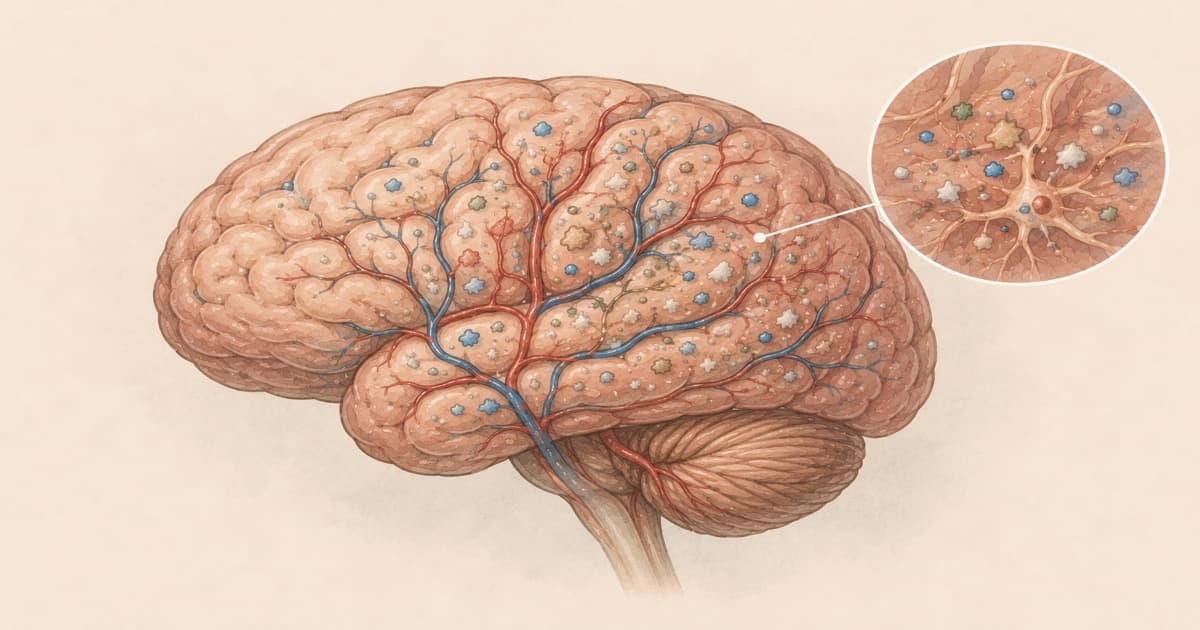
Microplastics have now been detected in human brain tissue at higher concentrations than in the liver or kidney. This is one of the most significant findings in the field — and one of the least understood.
Find out your current exposure level
12 questions · 2 minutes · based on peer-reviewed science
Key takeaways
- → Microplastics were found in 100% of human brain tissue samples tested, at higher concentrations than matched liver and kidney samples (Nihart et al., 2025)
- → The most prevalent polymer in brain tissue was polyethylene — the world's most commonly produced plastic
- → Brain microplastic concentrations appear to have increased significantly over recent years, tracking global plastic production trends
- → The most likely entry route is the bloodstream: research has detected plastic particles in human blood, and the smallest particles are thought to cross the blood-brain barrier
- → A secondary route is the olfactory nerve — inhaled particles can travel directly to the brain, bypassing the blood-brain barrier entirely
- → Causation of neurological harm has not been established in humans, but animal studies show neuroinflammatory responses at comparable concentrations
The landmark finding: microplastics in every brain sample
Nihart et al. (2025), published in Nature Medicine, analysed brain tissue, liver, and kidney samples from autopsy donors. The study found microplastics in 100% of brain tissue samples — and crucially, in higher concentrations than in matched liver and kidney samples from the same donors. The brain, normally protected by the blood-brain barrier, appears to accumulate plastic particles at higher levels than the body's primary detoxification organs.
The most prevalent polymer detected in brain tissue was polyethylene — the world's most widely produced plastic, used in bags, bottles, and packaging. Other polymers identified included polypropylene and PVC. The study also noted an association between higher brain microplastic concentrations and a diagnosis of dementia, though the authors were careful to characterise this as an association requiring further investigation, not evidence of causation.
The finding that the brain accumulates microplastics at higher concentrations than the liver and kidney — organs specifically involved in filtering waste from the bloodstream — was unexpected and is not yet fully explained. One hypothesis is that the brain's high lipid content attracts lipophilic plastic polymers, which tend to concentrate in fatty tissue.
Concentrations are rising
The Nihart et al. study compared brain tissue samples collected at different time points and found evidence that microplastic concentrations in human brain tissue have increased significantly in recent years — consistent with the rapid acceleration in global plastic production over the same period. There is no baseline of zero for any living human; the question is the rate at which accumulation continues.
This trajectory matters because microplastics are not readily cleared from brain tissue. Unlike water-soluble substances that the kidneys can filter and excrete, plastic particles are not metabolised or excreted through normal biological processes. Once in brain tissue, clearance of particles through normal biological processes has not yet been characterised.
How do microplastics reach the brain?
Three routes are currently proposed in the research literature:
- Bloodstream via gut absorption — the primary route. Leslie et al. (2022) in Environment International confirmed the presence of microplastics in human blood — particles were quantifiable in 77% of donors. The paper notes that the precise uptake route cannot be determined from blood measurements alone, and describes gut absorption as scientifically plausible rather than confirmed. Very small particles — particularly nanoplastics below 1 micron — can then cross the blood-brain barrier, a membrane that normally prevents most large molecules from entering brain tissue. Larger microplastic particles are thought to be transported by immune cells (macrophages) which can also cross this barrier.
- Olfactory nerve pathway — inhaled particles that reach the nasal passages can travel along olfactory nerve fibres directly into the brain, bypassing the blood-brain barrier entirely. This route is consistent with the finding of microplastics in olfactory bulb tissue and has been explored in animal model research. It is one reason why airborne microplastic exposure — from indoor dust, synthetic textiles, and outdoor sources — is considered a direct neurological exposure pathway, not just a respiratory one.
- Direct translocation from inhalation — very small particles reaching the deep lung (alveoli) can cross into the bloodstream and subsequently reach the brain via circulation. This is an extension of the bloodstream route but has a distinct entry point from ingestion.
What do microplastics do in the brain?
The human research on health effects in brain tissue is at an early stage — the detection of particles is better established than the characterisation of their effects. Animal studies provide the strongest mechanistic evidence:
Research in animal models has found that microplastic particles in brain tissue are associated with neuroinflammatory responses — including activation of microglia (the brain's immune cells) and elevation of inflammatory markers. Oxidative stress has also been reported in exposed brain tissue. Some animal research has found behavioural changes including impaired memory and altered anxiety responses, though translating these findings to human exposure levels requires caution.
In the human literature, the Nihart et al. association between higher brain concentrations and dementia diagnosis is the most significant finding to date. Whether this reflects microplastics contributing to neurodegeneration, or whether neurodegeneration creates conditions that promote particle accumulation, is not yet established. It is also possible the association reflects a third factor — for example, that people with conditions predisposing them to dementia have higher exposure to microplastics through behavioural or occupational routes.
Why the brain specifically?
The finding that the brain accumulates more microplastics than the liver or kidney is counterintuitive. The blood-brain barrier exists specifically to restrict what enters brain tissue — it is one of the most selective barriers in human biology. Several hypotheses are being explored:
- Lipid affinity — many plastic polymers and their chemical additives are lipophilic (attracted to fats). Brain tissue is approximately 60% fat, making it a preferential accumulation site for lipophilic particles and chemicals.
- Limited clearance — unlike the liver and kidney, the brain does not have dedicated mechanisms for filtering and excreting particles. The glymphatic system (the brain's waste clearance system, active during sleep) may play a role, but its capacity for plastic particle clearance is not established.
- Olfactory route contribution — if a significant fraction of brain microplastics arrive via the olfactory nerve, they may bypass the comparative filtration capacity of the gut and liver entirely.
What is not yet known
The human research is still at the stage of establishing presence and association rather than mechanism and causation. Key open questions include: what concentration of microplastics in brain tissue constitutes a threshold for harm (if any threshold exists); whether specific polymer types are more harmful than others; what the role of chemical additives leaching from plastic particles in brain tissue is; and whether the rate of accumulation is linear with ongoing exposure.
The absence of established causation does not mean absence of risk — it reflects the difficulty of studying these questions in living humans. The precautionary conclusion supported by the evidence is that plastic accumulation in brain tissue is real, is increasing, and that reducing ongoing microplastic exposure — through the highest-impact changes available — is a reasonable response while the science develops.
What this means for exposure reduction
Given that both ingested and inhaled microplastics are plausible routes to the brain, the most impactful exposure reductions target both pathways. On the ingestion side: filtering drinking water, eliminating plastic tea bags, and avoiding microwaving food in plastic are the highest-leverage food-pathway changes. On the inhalation side: reducing synthetic textile dust indoors (frequent vacuuming with a HEPA filter, washing synthetic clothing before first use) and improving ventilation addresses airborne particle exposure.
No intervention has been shown to remove microplastics from brain tissue once accumulated. The focus of evidence-based exposure reduction is on reducing the rate of ongoing intake, not reversing accumulation that has already occurred. To see how your current habits compare across all major exposure pathways, take the calculator below.
Related articles
Find out your personal exposure
12 questions · 2 minutes · peer-reviewed science
Start the calculator →References
- Nihart AJ et al. Bioaccumulation of microplastics in decedent human brains. Nat Med. 2025. DOI: 10.1038/s41591-024-03453-1
- Leslie HA et al. Discovery and quantification of plastic particle pollution in human blood. Environ Int. 2022. DOI: 10.1016/j.envint.2022.107199