Microplastics in Tap Water: How Much Are You Drinking?
Tap water is not microplastic-free. But the evidence consistently shows it contains far fewer particles than bottled water — and simple interventions can reduce exposure further. Here is what the research shows.
Find out your current exposure level
12 questions · 2 minutes · based on peer-reviewed science
Key takeaways
- → Microplastics have been detected in tap water globally — but treated municipal water typically has far lower concentrations than bottled water
- → A systematic review found maximum tap water contamination of 628 particles/litre vs 4,889 particles/litre for bottled water in European samples (Danopoulos et al., 2020)
- → Fragments are the most common microplastic shape found in tap water, with fibres second — consistent across multiple studies including the 2020 Danopoulos systematic review
- → Water treatment plants remove a significant proportion of microplastics but not all — final removal rates vary by treatment process and particle size
- → Boiling hard tap water removes at least 80% of microplastics at no cost (Yu et al., 2024); reverse osmosis removes more than 99%
Is tap water contaminated with microplastics?
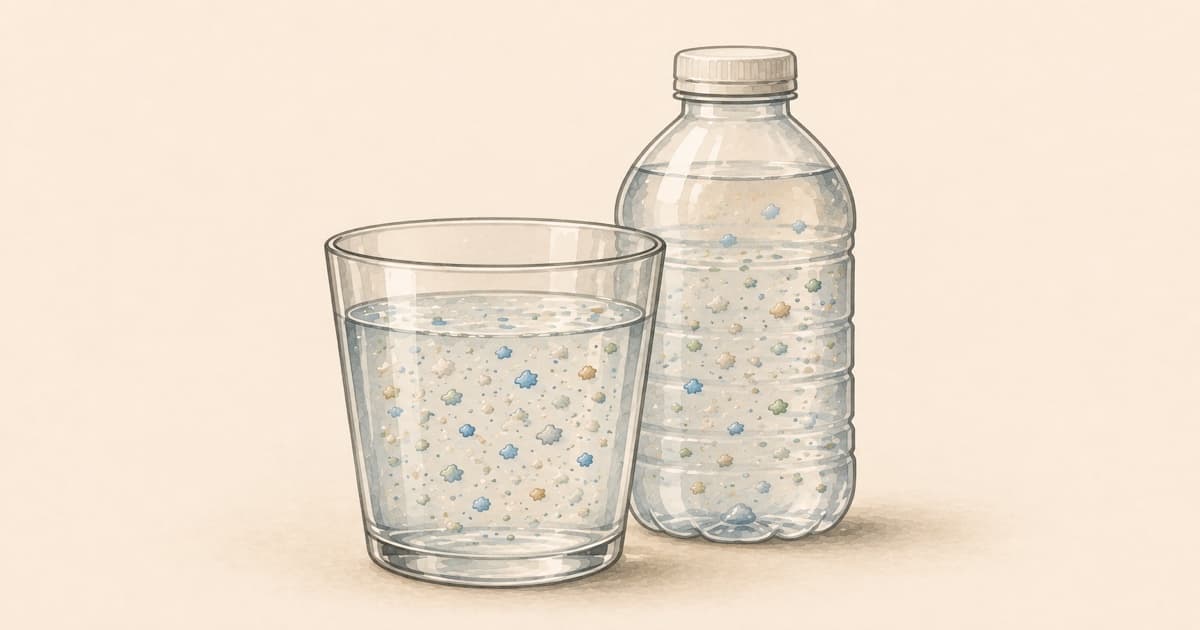
Yes — microplastics have been detected in tap water samples from every region of the world where studies have been conducted. A 2020 systematic review by Danopoulos et al. in PLOS ONE, covering 12 studies across tap and bottled water, found microplastic contamination in tap water in all locations studied. Across the tap water studies reviewed, fragments were the most commonly identified particle shape, with fibres the second most common.
The contamination is real but it needs context: treated tap water in developed countries consistently shows lower particle concentrations than bottled water. The review found maximum contamination of 628 microplastic particles per litre for tap water versus 4,889 particles per litre for bottled water in European samples. The direction of the evidence is consistent — tap water is a lower-exposure option than bottled water for most people in markets with treated municipal water.
Where do microplastics in tap water come from?
There are three main entry routes:
- Wastewater treatment effluent — synthetic fibres shed from clothing during washing are too small for standard wastewater treatment to fully capture. They pass into rivers and lakes that serve as drinking water sources. This is the dominant contamination pathway in most studies.
- Atmospheric deposition — microplastic fibres and fragments carried by air settle into open reservoirs and water sources. Studies in remote locations including mountain lakes with no nearby industry have detected microplastics, confirming atmospheric transport as an independent pathway.
- Distribution infrastructure — ageing water pipes, particularly PVC pipes, can shed particles into water as it travels from treatment plants to taps. This contributes a small fraction of overall contamination but is difficult to control at the household level.
What does water treatment remove?
Modern drinking water treatment — which typically includes coagulation, flocculation, sedimentation, and filtration before disinfection — removes a significant proportion of microplastics, but not all. Pivokonský et al. (2018) in Science of the Total Environment studied three Czech drinking water treatment plants and found that while treatment substantially reduced microplastic counts, particles in the smallest size fractions (particularly those below 10 microns) were the hardest to remove and were still present in finished drinking water — accounting for up to 95% of particles detected.
The efficiency of removal depends heavily on the treatment technology used, the particle size distribution in the source water, and whether membrane filtration stages are included. Plants using membrane ultrafiltration or nanofiltration achieve higher removal rates than those relying solely on conventional sedimentation and sand filtration. In many municipal systems, treatment is effective for larger particles but allows smaller microplastics and nanoplastics to pass through to the distribution network.
How does tap water compare to bottled water?
The comparison consistently favours tap water for microplastic exposure. Mason et al. (2018) found bottled water averaged 325 microplastic particles per litre across 259 bottles from 11 global brands — with polypropylene, the plastic most commonly used to make bottle caps, identified as the dominant polymer type, suggesting the packaging and bottling process as a primary contamination source rather than the water itself. Bottled water is not a solution to microplastic exposure from drinking water; it introduces a different and typically larger source of contamination.
The conclusion across the literature is clear: for people concerned about microplastic exposure from drinking water, the answer is not to switch to bottled water but to filter tap water.
How to reduce microplastics from tap water
Several options are well-supported by the evidence, ranked by removal efficiency:
- Reverse osmosis — the strongest available option. RO membranes have pore sizes of approximately 0.0001 microns, which is far smaller than any known microplastic particle. An intact membrane provides no physical pathway for microplastic particles to pass through — removal is a function of pore size rather than a measured average. The most reliable choice for households prioritising maximum reduction.
- Activated carbon block filters — performance varies significantly by product quality. High-quality carbon block filters rated for sub-micron particles can capture a meaningful proportion of microplastics. However, research has shown that lower-quality filters with plastic housings can shed particles into the water, resulting in higher microplastic counts than unfiltered tap water (Da Costa et al., 2024). Filter housing material and build quality matter as much as the stated pore size.
- Boiling hard tap water — Yu et al. (2024) in Environmental Science & Technology Letters found that boiling hard water (above 120 mg/L of calcium carbonate) removed at least 80% of free-floating microplastics and nanoplastics. The mechanism is calcium carbonate precipitating around plastic particles during boiling and trapping them in the resulting scale. Decanting the cooled water carefully — leaving the sediment behind — maximises the effect. In soft water areas, the calcium carbonate concentration is insufficient to drive this process effectively, so the benefit is considerably lower.
- Standard pitcher filters — not reliably effective for microplastic removal. Brita-style granular activated carbon pitchers have pore sizes of around 20–50 microns, meaning the majority of tap water microplastics — which are typically smaller than this — pass straight through. These filters improve taste and reduce chlorine, but should not be relied upon for microplastic reduction.
For a full comparison of filter types and removal rates, see the ranked guide to water filters for microplastics.
How significant is tap water as an exposure source?
Humans are exposed to microplastics through multiple routes simultaneously — drinking water, food, and air — and the WHO (2019) noted that understanding the relative contribution of each pathway requires considerably more research. What is clear is that drinking water is a consistent, daily route of exposure that accumulates over time, and that it sits alongside rather than above other significant pathways. Food preparation habits — particularly microwaving in plastic, using plastic cutting boards, and drinking from plastic tea bags — are among the other high-exposure sources worth addressing in parallel.
That said, water is consumed multiple times daily, making it a consistent and cumulative source. Filtering tap water is one of the most straightforward high-impact reductions available — particularly for households with infants, where formula preparation using filtered water meaningfully reduces the dose compared to unfiltered or bottled water.
Is tap water safe to drink?
The presence of microplastics in tap water does not make it unsafe to drink in the conventional sense. Regulatory bodies including the WHO have reviewed the available evidence and have not concluded that microplastics in drinking water at detected concentrations represent an established health hazard at present — while acknowledging that the long-term research is ongoing. The WHO published a detailed review of microplastics in drinking water in 2019 noting the need for more research but not recommending avoidance of tap water.
The more accurate framing is that microplastics in tap water represent a cumulative exposure source whose long-term health implications are being actively studied. The precautionary approach — filtering tap water to reduce exposure where practical — is reasonable, low-cost, and does not carry any downsides.
Related articles
Find out your personal exposure
12 questions · 2 minutes · peer-reviewed science
Start the calculator →References
- Danopoulos E et al. Microplastic contamination of drinking water: a systematic review. PLOS ONE. 2020. DOI: 10.1371/journal.pone.0236838
- Pivokonský M et al. Occurrence of microplastics in raw and treated drinking water. Sci Total Environ. 2018. DOI: 10.1016/j.scitotenv.2018.08.102
- Mason SA et al. Synthetic Polymer Contamination in Bottled Water. Front Chem. 2018. DOI: 10.3389/fchem.2018.00407
- Yu Z et al. Drinking Boiled Tap Water Reduces Human Intake of Nanoplastics and Microplastics. Environ Sci Technol Lett. 2024. DOI: 10.1021/acs.estlett.4c00081
- Da Costa ID et al. Are Water Filters Effective Against Microplastics? Water. 2024;16(22):3189. DOI: 10.3390/w16223189
- World Health Organization. Microplastics in Drinking-water. Geneva: WHO; 2019.