Microplastics and Pregnancy: What the Research Shows
Microplastics have been detected in human placenta and in newborn meconium — confirming that fetal exposure begins before birth. Here is what the peer-reviewed evidence shows and what can be done about it.
Find out your current exposure level
12 questions · 2 minutes · based on peer-reviewed science
Key takeaways
- → Microplastics have been confirmed in human placenta (Ragusa et al., 2021) and in newborn meconium (Liu et al., 2022) — fetal exposure is established, not theoretical
- → Microplastics were also detected in meconium (a newborn's first bowel movements), confirming particles accumulate in the fetal gut before birth
- → Animal studies show microplastic exposure during pregnancy is associated with reduced fetal weight, placental inflammation, and altered fetal organ development
- → The fetal period is a developmentally sensitive window — organs including the brain, liver, and immune system are forming and may be more susceptible to environmental exposures
- → No human trial has established causation of specific adverse outcomes, but the precautionary case for reducing exposure during pregnancy is well-supported
Microplastics in the placenta: the first evidence
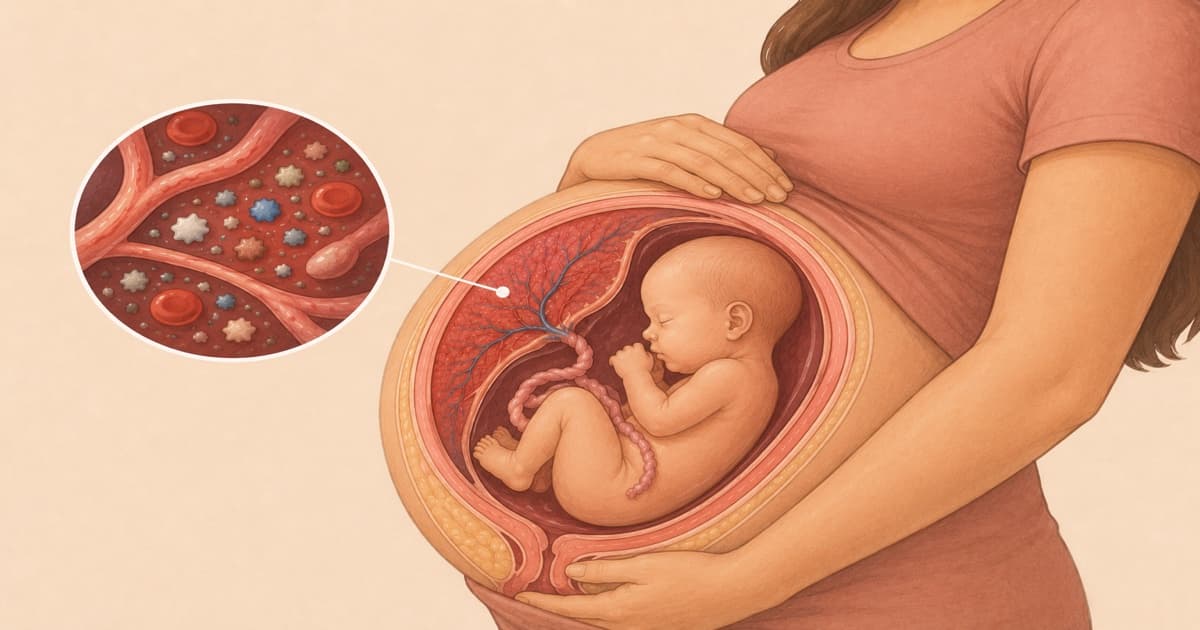
The placenta was long considered a robust barrier between the maternal and fetal circulatory systems. Ragusa et al. (2021) in Environment International — in a study they named "Plasticenta" — was the first peer-reviewed study to confirm microplastic particles in human placenta tissue. The team analysed full-term placenta samples from six healthy women with normal pregnancies and uncomplicated deliveries. Microplastics were detected in four of the six placentas, found across the fetal and maternal sides of the tissue and in the chorioamniotic membranes.
The particles identified were predominantly pigmented fragments consistent with coatings used in personal care products and paints — suggesting multiple environmental exposure routes rather than a single source. The finding established that the placental barrier does not reliably prevent microplastic particles from crossing between maternal and fetal circulation.
Amniotic fluid and meconium: exposure confirmed in utero
Liu et al. (2022) in Science of the Total Environment analysed placenta, meconium, infant feces, breast milk, and infant formula from 18 mother-infant pairs and detected microplastics across all sample types. Microplastic presence in meconium — the dark, tarry substance that constitutes a newborn's first bowel movements, composed of material accumulated in the fetal gut during gestation — confirms that particles ingested or inhaled by the mother can reach the fetal gut before birth. Studies using meconium as a biomarker are particularly useful because the substance accumulates over the entire gestational period and provides a proxy measure of in utero exposure.
Why the fetal period matters
The developing fetus is not simply a smaller version of an adult — it is an organism in a sensitive critical window of development during which environmental exposures can have disproportionate and lasting effects. Key developmental processes occurring during pregnancy include:
- Neurological development — the brain forms rapidly during the first and second trimesters, with neural tube closure, cortical development, and synaptic formation all occurring in windows where disruption can have lasting consequences.
- Immune system programming — the fetal immune system is calibrated by its early environment. Inflammatory signals during fetal development, including those potentially triggered by microplastic particles, could influence immune function long after birth.
- Endocrine development — hormone signalling drives organ differentiation during fetal development. Many plastic additives (including phthalates and bisphenols used in plastic production) are endocrine disruptors. While these are chemicals associated with plastic, not the plastic particles themselves, they can migrate from particle surfaces into surrounding tissue.
Fetal metabolising enzymes are also underdeveloped compared to adults, meaning the fetal capacity to process and clear foreign substances — whether chemical or physical — is substantially lower than in mature physiology.
What animal studies show
Human studies on pregnancy outcomes are limited to observational data on exposure — ethical constraints prevent deliberate microplastic exposure trials in pregnant women. Animal studies provide the mechanistic evidence:
Rodent studies of gestational microplastic exposure have found associations with reduced fetal body weight, altered placental morphology, increased placental inflammatory markers, and changes in fetal organ development. Some studies have found effects on the developing reproductive system in exposed offspring (Obeng et al., 2025). These findings are from animal models at exposure levels that may not directly translate to human dietary exposure, and they should not be interpreted as proof of equivalent outcomes in humans.
They are, however, biologically plausible findings that establish mechanisms by which gestational microplastic exposure could matter — and they are consistent with the broader pattern of animal studies in environmental health, where findings have often preceded human evidence by years.
What about breastfeeding?
Microplastics have also been detected in breast milk. Ragusa et al. (2022) in Polymers detected microplastics in 26 of 34 breast milk samples from an Italian cohort — the first peer-reviewed confirmation of this finding. This means that microplastic exposure does not end at birth for breastfed infants.
The presence of microplastics in breast milk does not mean breastfeeding should be avoided. The documented benefits of breastfeeding — including immune programming, nutritional completeness, and infant-mother bonding — are well-established and substantial. The microplastic contribution, while real, is one of many exposures infants encounter and should be weighed against these significant benefits. The appropriate response is to reduce the mother's microplastic intake, which reduces but does not eliminate the concentration in breast milk. For more, see the article on microplastics in baby formula and breast milk.
Practical steps to reduce exposure during pregnancy
The following changes address the largest documented microplastic exposure pathways and are safe, low-cost, and practical during pregnancy:
- Do not microwave food in plastic containers — this is the single highest-release kitchen activity for microplastic particles. Transfer food to glass or ceramic before heating.
- Replace plastic tea bags with loose leaf or staple-sealed paper bags — a single plastic tea bag releases billions of particles per cup. This is one of the largest individual exposure sources for regular tea drinkers.
- Filter drinking water — reverse osmosis or an activated carbon block filter reduces microplastic content in tap water substantially. Avoid bottled water, which contains more microplastics than filtered tap water.
- Switch to a wood or bamboo cutting board — plastic cutting boards shed particles with every knife stroke. A wooden board releases none.
- Use glass or stainless steel containers for hot food and drinks — heat accelerates particle release from plastic containers. Cold storage in plastic carries lower risk.
- Switch from plastic baby bottles to glass or stainless steel — particularly relevant for formula preparation, where polypropylene bottles used with boiling water release millions of particles per litre.
The honest state of the evidence
The research on microplastics and pregnancy is at an early but rapidly developing stage. What is established beyond doubt: microplastics reach the fetus. What is established in animal models: gestational exposure is associated with adverse developmental outcomes. What is not yet established in humans: specific causation of clinical adverse outcomes at the exposure levels currently detected.
Given the developmental sensitivity of the fetal period and the absence of any downside to the exposure reductions listed above, the precautionary case for acting on this evidence during pregnancy is stronger than in most other contexts. These are not difficult changes — and the cumulative reduction across the major pathways is substantial.
Related articles
Find out your personal exposure
12 questions · 2 minutes · peer-reviewed science
Start the calculator →References
- Ragusa A et al. Plasticenta: First evidence of microplastics in human placenta. Environ Int. 2021. DOI: 10.1016/j.envint.2020.106274
- Liu S et al. Detection of various microplastics in placentas, meconium, infant feces, breastmilk and infant formula: A pilot prospective study. Sci Total Environ. 2022. DOI: 10.1016/j.scitotenv.2022.158699
- Ragusa A et al. Raman Microspectroscopy Detection and Characterisation of Microplastics in Human Breastmilk. Polymers. 2022. DOI: 10.3390/polym14132700
- Li D et al. Microplastic release from the degradation of polypropylene feeding bottles during infant formula preparation. Nat Food. 2020. DOI: 10.1038/s43016-020-00171-y
- Obeng EM et al. Microplastic pollution: a review of specific blood-tissue barrier breaches and health effects. Environ Pollut. 2025;376:126416. DOI: 10.1016/j.envpol.2025.126416